
Table of Contents
Quick Summary
SEO vs SEM comes down to long-term authority versus immediate visibility. SEO builds sustainable organic traffic, trust, and AI Overview eligibility over time, while SEM delivers instant results through paid ads. In 2026, high-performing brands use SEO for compounding growth and SEM to capture short-term, high-intent demand.
Search visibility is no longer just about ranking on Google. In 2026, brands compete across organic results, paid ads, AI Overviews, featured snippets, and zero-click answers. This is where the SEO vs SEM debate becomes critical—not as a theory, but as a business decision.
In this guide, we break down SEO vs SEM, explain the real differences, clarify what most articles get wrong, and show which strategy works best based on goals, budgets, timelines, and risk tolerance—backed by real-world experience.
What Is the Difference Between SEO and SEM?
SEO (Search Engine Optimization) focuses on earning organic visibility through content, technical optimization, and authority building, while SEM (Search Engine Marketing) drives visibility instantly using paid ads on search engines like Google Ads. The key difference is time vs cost control—SEO compounds over time, SEM delivers immediate results but stops when spend stops.
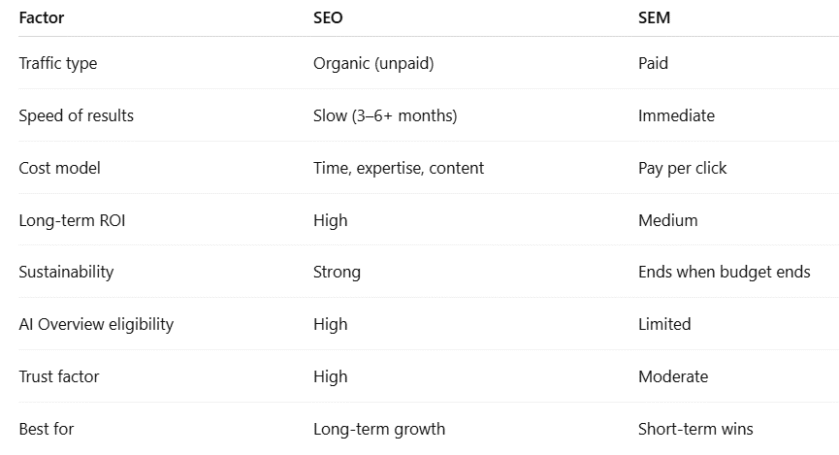
SEO vs SEM at a Glance
What Is SEO and How Does It Actually Work in 2026?
SEO is the process of improving a website’s visibility in organic search results by aligning content, technical structure, and authority with how modern search engines evaluate usefulness and trust.
In practice, SEO today is not just keywords and backlinks. From our experience working with real client sites, modern SEO includes:
- Topical authority, not isolated pages
- Entity-based content (brands, tools, concepts clearly connected)
- Experience-driven insights (not generic definitions)
- Optimization for AI Overviews, not just blue links
Core SEO Components That Still Matter
- Content quality (depth, originality, usefulness)
- Technical SEO (Core Web Vitals, crawlability, indexing)
- On-page optimization (intent matching, structure)
- Authority & trust signals (brand mentions, links, consistency)
What Most SEO Articles Get Wrong?
Most guides still frame SEO as a tactical checklist. In reality, SEO is a long-term demand capture system. You do not “do SEO” once—you build search equity.
Also Read: What Is SEO?
What Is SEM and How Does It Work Today?
SEM refers to paid search marketing where brands bid on keywords to display ads on search engines, most commonly via Google Ads.
Unlike SEO, SEM offers:
- Immediate visibility
- Precise targeting
- Budget control
- Fast testing
From real campaign data we’ve seen, SEM is often used to:
- Launch new products
- Capture high-intent keywords
- Support seasonal campaigns
- Validate keyword value before SEO investment
Common SEM Formats
- Search ads (text-based)
- Shopping ads
- Performance Max campaigns
- Branded keyword protection
What SEM Cannot Replace
SEM does not build authority. Users know ads are paid. Trust, especially in high-consideration industries, still leans toward organic results.
SEO vs SEM: Which One Is Better for Your Business?
Neither SEO nor SEM is universally better—the right choice depends on your goals, timeline, budget, and competitive landscape.
Choose SEO If:
- You want sustainable, compounding traffic
- You are building long-term brand authority
- You want visibility in AI Overviews and snippets
- You can wait 3–6 months for results
Choose SEM If:
- You need leads or sales immediately
- You are running time-sensitive campaigns
- You operate in highly competitive SERPs
- You have a clear CAC target
Also Read: How Do Search Engine Work?
SEO vs SEM for ROI: What Delivers Better Returns?
SEO typically delivers higher ROI over time, while SEM offers faster but cost-bound returns.
From real client benchmarks:
- SEO-driven leads often cost 40–60% less after maturity
- SEM costs rise as competition increases
- SEO content continues generating traffic even after investment stops
Hidden Cost Most Businesses Miss
SEM costs inflate over time due to:
- CPC increases
- Auction competition
- Click fraud risk
SEO costs decline per visit as authority grows.
SEO vs SEM Timeline: How Long Before You See Results?
SEO requires patience; SEM requires budget.
SEO Timeline
- Month 1–2: Foundation & content
- Month 3–4: Early impressions
- Month 6+: Stable traffic growth
SEM Timeline
- Day 1: Ads live
- Day 7: Performance data
- Day 30: Optimized campaigns
Critical insight: Businesses that abandon SEO too early often overpay for SEM long-term.
SEO vs SEM for AI Overviews and Zero-Click Searches
This is where many existing articles are outdated.
AI Overviews primarily pull from authoritative organic sources—not ads.
SEO advantages in AI-driven SERPs:
- Content citations
- Brand recall
- Zero-click exposure
- Long-term visibility even without clicks
SEM ads do not dominate AI Overviews yet. This makes SEO increasingly strategic in 2026+.
Also Read: How to Check Your Website SEO Audit?
Can SEO and SEM Work Together?
Yes—SEO and SEM perform best when integrated, not isolated.
Smart Integration Examples
- Use SEM data to identify high-converting keywords for SEO
- Protect branded keywords with ads while SEO matures
- Retarget SEO visitors with paid ads
- Fill SEO gaps temporarily with SEM
From real implementations, blended strategies often outperform single-channel approaches by 30–50%.
Common Mistakes Businesses Make with SEO vs SEM
Mistake 1:Expecting SEO to work like ads
SEO compounds; it doesn’t spike.
Mistake 2: Relying only on SEM
Traffic stops the moment budgets pause.
Mistake 3: Choosing based on cost alone
Cheap traffic is useless if it doesn’t convert.
Mistake 4: Ignoring intent differences
Not all keywords are worth paying for.
Also Read: How to Generate High-Quality Backlinks for SEO?
SEO vs SEM: Best Choice by Business Scenario
Best for Startups
- Short-term: SEM
- Long-term: SEO foundation
Best for Enterprise Brands
- SEO for authority
- SEM for campaign acceleration
Best for Local Businesses
- Local SEO first
- SEM for competitive categories
Best for E-commerce
- SEM for transactional keywords
- SEO for category and comparison pages
Also Read: Google’s Top 50 Ranking Signals
Final Verdict: SEO vs SEM — What Should You Do in 2026?
- If you want quick wins, choose SEM.
- If you want durable growth, choose SEO.
- If you want dominance, use both strategically.
In our experience, the most successful brands treat SEO as an asset and SEM as a lever—not substitutes, but complements.
Key Takeaways
- Use SEO to build long-term organic traffic, topical authority, and trust.
- Use SEM when you need immediate visibility, leads, or sales.
- SEO delivers higher ROI over time; SEM performance depends on ongoing ad spend.
- AI Overviews and featured snippets favor strong SEO, not paid ads.
- SEM is ideal for testing keywords before committing to SEO.
- The best strategy in 2026 combines SEO and SEM, not one or the other.
Frequently Asked Questions About SEO vs SEM
1. Is SEO still worth investing in when SEM can give instant results?
Yes, SEO is still worth investing in because it builds long-term visibility, trust, and cost efficiency that SEM cannot sustain alone. While SEM delivers instant traffic, SEO continues to generate qualified visits, brand recall, and AI Overview exposure even when ad spend pauses.
2. Can a business rely only on SEM and skip SEO entirely?
Relying only on SEM is risky because traffic stops the moment ad budgets are reduced or paused. Businesses that skip SEO often face rising acquisition costs over time and miss out on organic trust signals, featured snippets, and AI-driven search visibility.
3. Which is better for small businesses: SEO or SEM?
For small businesses, SEO is usually better for long-term growth, while SEM can support short-term lead generation. A balanced approach—local SEO for sustained visibility and limited SEM for high-intent keywords—often delivers the best results without overspending.
4. How does SEO vs SEM impact visibility in Google AI Overviews?
SEO has a much stronger impact on AI Overviews because Google primarily pulls insights from authoritative organic content. SEM ads may appear around AI results, but they are rarely cited as sources within AI-generated answers.
5. Is SEO cheaper than SEM in the long run?
Yes, SEO is generally more cost-effective in the long run. Although SEO requires upfront investment in content and optimization, the cost per visit decreases over time, whereas SEM costs continue to rise due to competition and increasing CPCs.
6. How do I decide which keywords should be SEO-focused vs SEM-focused?
High-intent, transactional keywords with strong commercial value are often better suited for SEM, especially early on. Informational, comparison-based, and research-driven keywords typically perform better with SEO and help build topical authority.
7. Does SEO still matter if my industry is highly competitive in Google Ads?
SEO matters even more in competitive industries because paid ads become expensive quickly. Strong SEO allows you to capture demand without paying for every click and helps establish brand credibility where users are skeptical of ads.
8. How long should I run SEM before shifting focus to SEO?
SEM should not replace SEO but support it. In practice, SEM is most useful in the first 3–6 months to validate keywords and generate immediate traffic while SEO foundations—content, authority, and rankings—are being built.
9. Can SEO and SEM data be used together effectively?
Absolutely. SEM performance data is valuable for SEO planning. Keywords with high conversion rates in paid campaigns often become priority targets for organic content, improving overall ROI and reducing long-term dependency on ads.
10. What changes in 2026 make SEO vs SEM decisions more important?
In 2026, AI Overviews, zero-click searches, and entity-based ranking systems make SEO critical for brand visibility beyond clicks. SEM still plays an important role, but businesses that ignore SEO risk losing influence in how search engines summarize and recommend information.
Need Expert Advice? Contact Headline Insider Today!
If you found this guide helpful, explore more in-depth articles on Headline Insider covering SEO strategy, AI-driven search trends, and digital marketing best practices.
If you’re evaluating SEO, SEM, or a blended growth strategy for your business and want practical, experience-backed guidance, you can also connect with Headline Insider’s SEO and digital marketing team to discuss what will work best for your goals—no hard sell, just informed direction.